
Some key objectives the Chancellor will want to meet are:
-
Covering the widely reported £22 billion hole
-
Making the UK pensions system less reliant on state support
-
Encouraging people to be more financially self-reliant
-
Encouraging investment in UK business
Defaqto’s Richard Hulbert has outlined four potential changes that could be announced, and how they’re likely to affect investors and savers.
1. Pension scheme to provide a side-car cash account
According to the Financial Conduct Authority (FCA), one in three UK adults has no savings or less than £1,000 readily available, leaving them vulnerable to cashflow shocks like unexpected bills.
Workplace pension provider, Nest’s sidecar initiative, which combines a savings account with its pension scheme, has proven effective in helping with budgeting, building emergency funds, and achieving short-term savings goals. Expanding this model to the 12 million+ pension holders in the accumulation phase could offer similar benefits to a wider population.
2. Using the tax-free cash allowance to incentivise larger saving while decreasing the future burden on the state
We can all take tax-free cash, with a few exceptions, equivalent to 25% of the value of our accumulated pension savings tax-free, up to a maximum of £268,275.
Ultimately, this allowance encourages 1 in 4 pounds saved tax efficiently to fund retirement to instead be spent on whatever the owner likes. This gives the UK economy and HMRC a boost as cars, kitchens, and holidays are purchased.
However, taking the cash results in a smaller income for the owner for the rest of their life, and potentially their dependents too. Which in turn makes both more likely to become reliant upon the state to financially support them later in life.
So, could the allowance be restructured to encourage saving and for the average retiree to see more value in boosting their income in retirement than taking the tax-free cash?
This could be done by retaining the 25% allowance but setting a threshold at which it becomes available. A minimum level of secure income required before tax-free cash becomes an option.
We can use the Pension and Lifetime Savings Association (PLSA) annual Retirement Living Standards report to help us set the threshold. This states a minimum level of income required in retirement, which in 2024/25 is £14,400 for a single person, excluding rent/mortgage costs.
With the state pension currently providing £11,502, this leaves those without an alternative income source some £2,900 below the PLSA minimum level. To put it another way, the state provides only 80% of the income needed.
To buy a secure inflation-linked lifetime income to make up the shortfall would currently require around £70,000 for a single person, non-smoker, in good health.
For someone on a UK average salary of £35,000 this would take about 15 years to accumulate. Bearing in mind the average working lifetime is 45-50 years and we have auto-enrolment with a compulsory 8% contribution rate this seems realistic.
Looking at this from a consumer’s perspective, hardly anyone knows how much they need to save. The £70,000 therefore becomes a minimum goal while also making it clear they will be rewarded for exceeding it through the 25% tax-free cash allowance.
This incentive works just as well for the self-employed as it does the employed. This is important, because currently some 4 million self-employed individuals are not saving for their retirement.
Further consideration needs to be given to how the system would work for:
- Couples, who according to PLSA require a minimum income of £22,400.
- Those with protected characteristics as defined by the Equality Act 2010, ie women and the disabled. This is because they are more likely to be earning lower amounts and/or part time and therefore may find the £70,000 parameter the hardest to reach.
3. Replacing tax-relief on pension contributions with a flat rate top-up
Currently savers can benefit from tax-relief on their pension contributions at their highest marginal income tax rate.
There are two ways this is administered, relief-at-source (RAS) and net-pay. Neither works for every employee and so could create claims of indirect discrimination brought under the Equality Act.
Table 2: Illustration of who benefits and loses out under each tax-relief system.
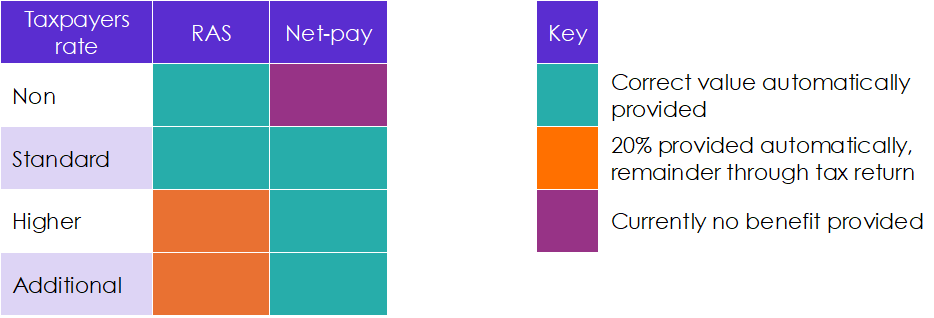
As you can see, non-taxpayers currently saving in a scheme that uses the net-pay system do not receive the relief to which they are entitled.
HMRC will start inviting those affected to receive correction payments from April 2025, however only for contributions made in 2024/25 and using a system fraudsters will recognise. Crucially, these payments will have limited appeal as they are relatively small in value, will be subject to income tax, and for those in receipt of Universal Credit a further 55% clawback.
Looking at the bigger picture and tax-relief currently costs government somewhere in the region of £60 billion. According to the Office for National Statistics, most of this value goes to higher and additional rate taxpayers.
This means, removing the additional benefit for higher and additional rate taxpayers could save more than £30 billion. Which is clearly more than sufficient to cover the £22 billion black hole.
Replacing RAS and net-pay with a flat rate of at least 20% will also remove the connection to the tax system.
From a consumer’s perspective, most savers will experience no difference. All non-taxpayers will receive the benefit they are entitled to. Higher and additional rate taxpayers will receive less, but importantly the same as everyone else as a percentage of their salary.
Further consideration needs to be given to defined benefit pension schemes. This is because they are dependent upon higher earners attracting the additional tax-relief to meet their future liabilities. However, this change may also create the environment in which the new style of pension, called Collective Defined Contribution (CDC), can become a potentially viable alternative.
I guess the decision for our new government is whether to continue with a complicated and expensive system that fosters inequality or move to a cheaper one that treats everyone the same.
4. Simplify ISAs and encourage investment in the UK
Currently, we can each place £20,000 per annum into an ISA and benefit from tax-free income and growth.
However, a large percentage of the £750 billion in ISAs is held in cash-based assets and international funds. This means they are benefitting from the UK tax system, while contributing very little to the economy.
At Defaqto we report on 775 different ISAs, distributed through five different types of ISA. With so many options the decision to drop the idea of a British ISA is welcomed. It also highlights the value created by impartial guidance such as Defaqto Star Ratings.
That said, our new government still has the desire for invested wealth, that attracts UK tax benefits, to be benefitting the UK.
Therefore, I suspect ISAs may be replaced or at least given a makeover. Introducing a compulsory 20% investment weighting towards UK registered equities and UK based infrastructure projects. Changes that are simple to understand, incentivise regular savings and ultimately drive investment in the UK.
While I would like to see the end of different types of ISA, within their replacement I can see value in offering cash bonuses for those saving to:
- buy their first home
- buy insurance against care costs
- make regular income payments to charity.